
It's Time To Beat
The Chinese At Their Own Game

It was a “crazy ass” week out there in the investment, political, and monetary world. I am not a greedy person, but I wish I had sold all of my Silver futures and bullion when the precious metal hit $120.00. I’m not that smart either. At least half of the positions are reduced to cash. Remember, greed kills.
What About The Dollar
It’s too high, says Trump. He may very well be right. Here’s what I think, and being a trader who thinks the Yen is headed towards 125, I think the Dollar is headed lower.
Let’s break this down into two key parts: why the U.S. dollar (USD) is considered “too high” and the potential consequences if it declines in value.
When analysts say the USD is “too high,” they mean that it is overvalued relative to other currencies, making American goods and services more expensive abroad while making imports cheaper. Several factors can drive dollar strength:
Interest Rate Differentials
The Federal Reserve has maintained higher interest rates than many other major central banks (e.g., the European Central Bank, Bank of Japan).
This attracts global capital into U.S. assets—especially Treasury bonds—because investors earn higher returns.
Increased demand for dollars to buy these assets boosts their value.
Safe-Haven Demand
In times of global uncertainty or geopolitical risk, investors flock to the dollar as a safe asset.
Events like wars, trade disputes, or financial instability elsewhere can push up the USD as a refuge currency.
Economic Resilience
The U.S. economy has shown relatively strong growth and lower unemployment compared to peers.
This leads market participants to expect the Fed to hold rates higher for longer—again supporting the dollar.
Global Reserve Currency Status
Roughly 60% of global foreign exchange reserves are held in dollars.
This structural demand keeps the USD persistently strong even when fundamentals like trade imbalances suggest it should weaken.
A decline in the dollar can have mixed effects—some positive, some negative—depending on the magnitude and pace of the depreciation.
Positive Effects
Improved Export Competitiveness
U.S. goods and services become cheaper abroad, boosting exports and potentially narrowing the trade deficit.
Companies like Boeing, Caterpillar, and large agricultural exporters could benefit.
Higher Corporate Earnings
U.S. multinationals (Apple, Coca-Cola, Microsoft) earn substantial revenue overseas.
When those foreign earnings are converted back into a cheaper dollar, reported profits rise.
Tourism and Manufacturing Support
A weaker dollar makes the U.S. more affordable for visitors and encourages domestic manufacturing investment.
Negative Effects
Imported Inflation
Imported goods (energy, commodities, consumer electronics) become more expensive.
This raises overall inflation, potentially forcing the Fed to keep rates higher for longer.
Reduced Global Buying Power
A weaker dollar diminishes the relative wealth of American consumers and investors abroad.
Traveling or investing overseas becomes more costly.
Foreign Investor Retreat
If the dollar drops too sharply, global investors might perceive rising risk and pull back from U.S. assets.
That could tighten financial conditions and put pressure on asset markets.
A True Balancing Act
Ideally, policymakers aim for a moderate, stable dollar:
Too strong → hurts exports and manufacturing.
Too weak → risks inflation and financial instability.
A gradual dollar decline, driven by narrowing interest-rate differentials or a global economic recovery, would likely be healthy and sustainable. But a sharp or disorderly fall could trigger market volatility, capital outflows, and renewed inflation concerns.
I think it is heading lower, and the “Red Man” in the White House agrees. How about you?
Outthink The Chinese
This is a very perceptive and strategic way to look at the dynamics between the U.S. and China, especially in the context of rare earth elements (REEs), which are the ones absolutely central to clean energy, defense, and advanced technology supply chains. Let’s unpack this carefully.
Why Are Rare Earths Geopolitically Important
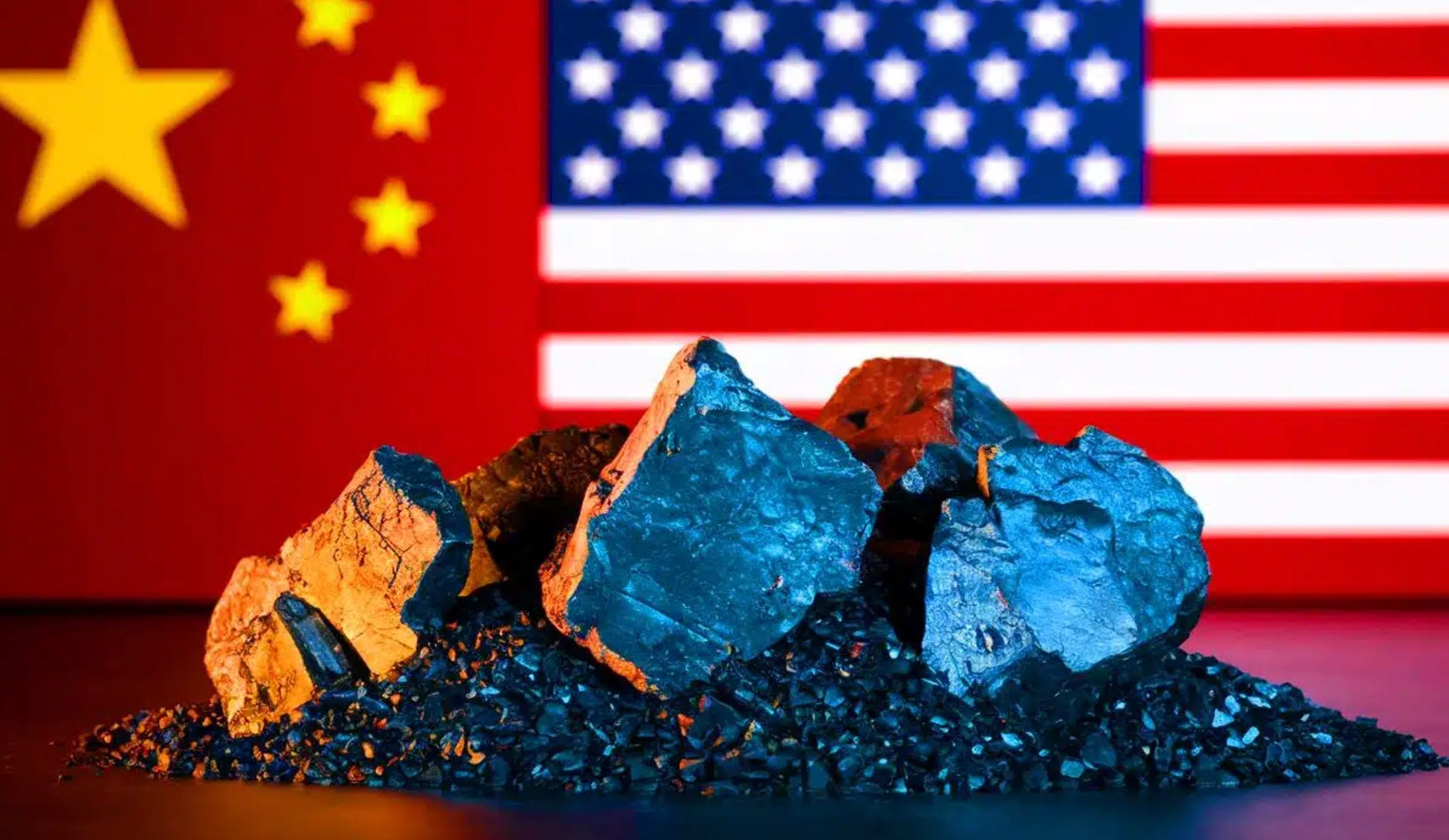
Rare earths aren’t physically rare, but they’re geographically concentrated in China, which controls over 70% of global production and refining capacity.
The U.S. (and allied nations like Japan and the EU) rely heavily on Chinese exports of refined REEs — not because they lack the raw minerals, but because:
Refining is environmentally challenging and highly chemical-intensive.
China invested heavily in processing infrastructure, subsidies, and lax regulations decades ago.
This creates a strategic vulnerability, if political tensions rise, China can restrict supplies, disrupting industries from semiconductors to EV batteries to advanced military systems.
Revenge Works
Developing better, cleaner ways to refine and produce rare earths isn’t really about revenge; it’s about strategic autonomy and technological leadership. However, there’s a power dynamic: out-innovating China effectively neutralizes one of its economic chokepoints.
If the U.S. or its partners build an advanced, scalable, environmentally safe refining ecosystem, a few things happen:
China’s economic leverage over critical minerals diminishes.
Western nations strengthen supply chain resilience.
New technologies in materials science, hydrometallurgy, and recycling create competitive export industries.
Which Pathways Exist
If we were to prioritize project types, here are the most impactful avenues — ranked by strategic and technical payoff:
Cleaner / Modular Refining Technologies
Objective: Replace conventional solvent extraction with cleaner, faster, and smaller-scale processes.
Example:
Bioleaching using microbes to separate rare earths.
Ionic liquids or electrochemical extraction with minimal chemical waste.
Impact: Reduces environmental footprint, allows domestic production near mining sites, and scales faster than legacy Chinese plants.
Rare Earth Recycling & Urban Mining
Objective: Recover REEs from e-waste, magnets, and batteries.
Example:
Pyrometallurgical recycling from wind turbine magnets and EV motors.
Closed-loop systems integrated into domestic manufacturing chains.
Impact: Significantly cuts dependence on new Chinese material and mitigates mining pollution.
Advanced Separation Materials
Objective: Develop next-gen membranes or adsorbents tailored to selectively capture specific REEs (like neodymium or dysprosium).
Impact: Breakthroughs here could fundamentally lower costs and energy use in refining.
Strategic Public-Private Partnerships
Objective: Forge alliances between government R&D, start-ups, and universities to scale pilot technologies.
Example:
DOE grants to U.S. national labs.
Australia-U.S.-Japan supply chain trilateral programs.
Impact: Address financing gaps and encourage technology sharing across industries.
This is the pathway we are taking, using “physics” that is older than most of you who are reading this.
Alternative Material Substitution
Objective: Reduce or eliminate the need for REEs by developing substitutes (e.g., ferrite magnets).
Impact: Long-term independence from rare earths themselves — potentially the ultimate “revenge” move.
Where We Are Heading
If I had to choose one priority project type, I’d go with investing in many advanced, modular, and clean refining technologies, backed by strong R&D and public-private partnerships.

Why?
It directly tackles the bottleneck (refining, not extraction).
It’s scalable, exportable, and geopolitically stabilizing.
It leverages U.S. strengths in innovation, process engineering, and environmental management.
This path positions the U.S. to lead a new global industry standard, not just chase China’s model, but the word “revenge” is better suited to our philosophical identity, “REEvenge”. Keep your eye out for our patents and the book. It’s just the way we roll.
Winning. That’s the only solution. We, the United States, gave away our thoughts, our technology, our manufacturing capabilities, and more. So many of those we run into are just looking to recreate the old. Not us, we’re looking for a better way, one that is working in the labs that can be converted commercially. The market is ready for some change to a better way, a more environmentally-friendly way to do something better than the Chinese. Give us a couple years than watch. We’ll be part of the future, not the past.